Tue. May 26th, 2026
Spread the love


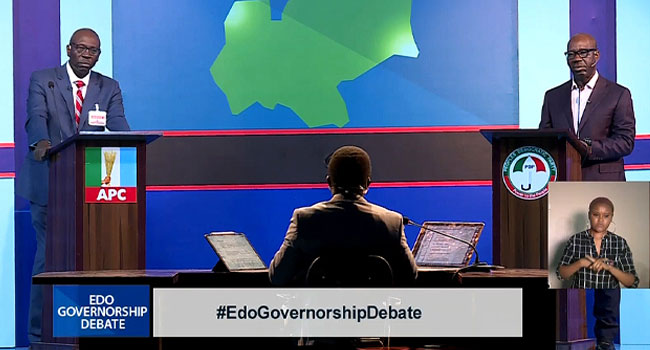
Governorship Candidates of the two Major Parties in Edo State were on Sunday at each other’s throats raising claims and counter-claims in their bid to position themselves ahead of the September 19 polls.

Governor Godwin Obaseki of the Peoples Democratic Party (PDP) and Mr. Osagie Ize-Iyamu threw some dirt on each other on Sunday when they participated in the governorship debate put together by Channels Television and its partners.

At the event, the candidates came at each other with several allegations. The most heated attacks, however, bordered on their educational qualifications, and alleged participation in cultism.


Under Four Years We Created 157,000 Jobs – Gov Obaseki

Obaseki ‘Wasted Over 75bn’ On Projects That Were Not Well Thought Out, Says Ize-Iyamu


When in June Obaseki dumped the APC after his disqualification from participating in the primary that produced Ize-Iyamu as the flag-bearer of the party, there were claims that the governor was disqualified based on certain bordered on inconsistencies in his certificate.

Reacting to these claims at the debate arena in Benin, the Edo State capital, the governor said, “it is very ironic that someone who has no certificate can stand up and comment on someone whose certificate was issued by the premier university in Nigeria. That is a very sad situation that we have found ourselves in as a country.

“In 1976 when I gained admission into the University of Ibadan, there was no JAMB; you could either go into the university through prelim or through Direct Entry in your advanced level examination. I finished my O Level and my Advanced Level and it was As, so I gained admission into the University of Ibadan in 1976.

“I don’t know what has happened but for the University of Ibadan, the standard is still very high and they have come out to say that I graduated from that university. How else do you want to make that clear?

“It is very sad that in a country like Nigeria, some people who do not have the qualifications, have the effrontery to challenge the qualifications of those who went to proper schools. It is sad.”


Where Are The Jobs? Ize-Iyamu Challenges Obaseki On Job Creation Claim

Edo Election: My Predecessor Borrowed Recklessly, Says Obaseki

Ize-Iyamu’s Thinking About Governance Has To Change, Says Obaseki


Similarly, Mr. Ize-Iyamu the APC candidate has been accused of partaking in some occultic activity that led to his expulsion while an undergraduate at the University of Benin, but the pastor described the allegation as a ploy to dent his character ahead of the polls.

He said, “I graduated from the University of Benin. I was very active in the students’ union and my records are clear.

“People have alleged that when you were in school, you did that but I think they should go to the university authorities and find out exactly what was the offence. If you do something very criminal, the university cannot even handle it. And I am proud that throughout my stay, I was not engaged in any criminal matter.”

Reacting to the Obaseki certificate issue, Ize-Iyamu said no one doubts that Obaseki went to the university, adding that the issue is that the governor failed by his own records.

“You failed school cert, you had three credits, no English, no Maths, even to enter A’ Level would have been difficult.

“And if you got A-Level, why is it that you’ve not been able to present the A-Level, where is the result? That is a moral question. A lot of people are looking up to you as a governor and as a leader.

“The question is that you failed your A-Level and that is why you were disqualified and your disqualification arose from information from the PDP, your party now, provided. Because the PDP, when I was contesting against you (in 2016) said you have no results. Why have you not answered the question? Where are your results?”

Viewers who tuned in for the two-hour debate between Osagie Ize-Iyamu of the APC and Governor Godwin Obaseki of the PDP on Sunday witnessed first hand the disagreements and issues that have seen the state witnessed one of the most controversial campaigns in recent years.

Both candidates, widely believed to be leading candidates for the September 19 election, disagreed on virtually every issue – job creation, debt profile, governance, qualification, and the facts that they built their plans on.

Beyond a handshake at the start of the debate, they would only agree on the need for community policing and the importance of a refinery project, the latter still sparked some disagreement.

By admin

You missed

From Tramadol to Canadian to Exol-5 The New Drug Destroying Nigerian Youths An Investigative Article .From Tramadol to Canadian to Exol-5: The New Drug Destroying Nigerian Youths An Investigative Report on the Shifting Landscape of Substance Abuse in Nigeria Nigeria faces a severe and evolving drug crisis, particularly among its youth. What began with the widespread abuse of Tramadol has progressed through mixtures like “Canadian” to newer pharmaceutical diversions such as Exol-5. This shift reflects deeper issues: easy access to prescription drugs, weak regulation, socioeconomic pressures, and aggressive street-level marketing. NDLEA operations and health studies reveal a public health emergency that threatens an entire generation. Phase 1: The Tramadol Epidemic (2010s–Early 2020s) Tramadol, a synthetic opioid prescribed for moderate to severe pain, became Nigeria’s most notorious street drug. Cheap, potent, and widely smuggled (often from India and other Asian countries), it offered users energy, euphoria, and pain relief — appealing to commercial drivers, laborers, students, and young men seeking confidence or stamina. Scale of the Problem: Millions of tablets seized annually by NDLEA. High prevalence among young males aged 15–35. Linked to increased crime, sexual violence, organ damage (kidney failure, seizures), and mental health breakdowns. Contributed to broader opioid misuse alongside codeine cough syrups. Government responses included tighter import controls and public awareness campaigns, but these only displaced demand to other substances rather than eliminating it. Phase 2: The Rise of “Canadian” (Mid-2020s) “Canadian” or “Canadian Loud” emerged as a popular code for high-grade cannabis (often indica-dominant strains) or cannabis mixed with other synthetics. It gained traction as users sought alternatives or combinations to Tramadol’s effects. This phase marked a move toward imported or locally cultivated premium weed, sometimes laced with stronger chemicals. Youths in urban centers like Lagos, Kano, Jos, and Onitsha embraced it for its perceived “cleaner” high compared to opioids. However, it fueled polydrug use — combining cannabis with opioids, sedatives, or alcohol — amplifying health risks. Phase 3: Exol-5 – The Current Threat (2024–2026) Exol-5 (Benzhexol Hydrochloride / Trihexyphenidyl 5mg), originally a prescription medication for Parkinson’s disease and drug-induced movement disorders, has become the latest pharmaceutical being heavily abused. Why Exol-5? Euphoric Effects: Users report intense euphoria, hallucinations, and a sense of detachment — making it attractive as a cheap “upper” or escape. Accessibility: Sold over-the-counter or on the black market despite being a controlled prescription drug. NDLEA has seized millions of pills in single operations (e.g., 3.1 million pills in Kano in late 2024, and over 5.6 million combined with Tramadol in other busts). Street Names: Exol, Artane, Benzhexol, “Farin Mallam” (in Northern Nigeria). Demographics: Prevalent among youths, laborers, and even psychiatric patients who divert prescriptions. Studies show abuse rates as high as 25% among certain outpatient groups. Health Consequences: Anticholinergic toxicity: Confusion, dry mouth, blurred vision, urinary retention, constipation, and in high doses — delirium, psychosis, seizures, and heart issues. Long-term: Cognitive impairment, addiction, exacerbated mental health disorders. Often mixed with Tramadol, codeine, or cannabis, creating dangerous synergies. In cities like Jos, Exol-5 sits alongside diazepam, Rohypnol, and Tramadol on street markets, easily available to teenagers and young adults. Why This Evolution Continues Supply-Side Failures: Porous borders, corrupt officials, and overproduction of pharmaceuticals enable diversion. Demand Drivers: Unemployment, poverty, peer pressure, trauma, and the pursuit of performance enhancement (e.g., for “hustle” culture). Weak Regulation: Many pharmacies sell restricted drugs without prescriptions. Online and street vendors fill gaps. Displacement Effect: Cracking down on one substance (Tramadol/codeine) pushes users and dealers toward the next available option. NDLEA reports ongoing large seizures, but the problem persists due to high profitability and low risk for mid-level distributors. Broader Impacts on Nigerian Youths Education: Increased dropout rates and poor academic performance. Mental Health: Rising cases of psychosis and depression. Economy: Lost productivity among the working-age population. Crime and Violence: Drug-fueled robberies, cultism, and family breakdowns. Public Health System Strain: Overburdened hospitals treating overdoses and chronic complications. Young people aged 15–39 remain the hardest hit, with national surveys showing drug use prevalence significantly above global averages. What Must Be Done Stronger Enforcement: Consistent prosecution of corrupt enablers and large-scale traffickers. Regulation: Crackdown on rogue pharmacies and better tracking of prescription drugs. Prevention & Rehabilitation: School programs, community outreach, and expanded treatment centers (currently woefully inadequate). Economic Alternatives: Address root causes like youth unemployment. Public Awareness: Honest campaigns highlighting real dangers of “Exol-5” and similar drugs. Conclusion From Tramadol’s opioid grip to “Canadian” cannabis culture and now Exol-5’s anticholinergic highs, Nigeria’s drug crisis is mutating faster than responses can contain it. Exol-5 represents the dangerous new frontier — a legitimate medicine turned youth destroyer due to misuse and greed. Without urgent, multi-layered intervention — combining supply disruption, demand reduction, and socioeconomic support — an entire generation risks being lost to addiction. The time for half-measures is over. Nigeria’s future depends on winning this fight.